

That glass of milk, that jar of “pure” honey, that bright red chilli powder — how sure are you that they’re actually what the label says? In India, food adulteration is common enough that it’s worth a few seconds of your time to check. The good news: you don’t need a lab. You need a glass of water, a few drops of iodine, and one minute.
The Food Safety and Standards Authority of India (FSSAI) literally published a manual of these quick home tests, called DART — Detect Adulteration with Rapid Test. This post pulls out five of the easiest and most useful, plus a printable card with ten more.
Why This Is Worth a Minute of Your Time
Adulteration isn’t always about a dramatic poison — it’s often quiet dilution and cheating that adds up. In one 2024 community study that tested 330 milk samples, this is what they found:
That’s one local study, not a national headcount — but the commonest problem was simply added water, followed by detergent, urea and neutralisers. Watered milk cheats your money and nutrition; if the water is unclean, it’s also an infection risk. Detergent and urea don’t belong anywhere near your body. That’s why a quick check is worth it.
The 5 Simple Home Tests
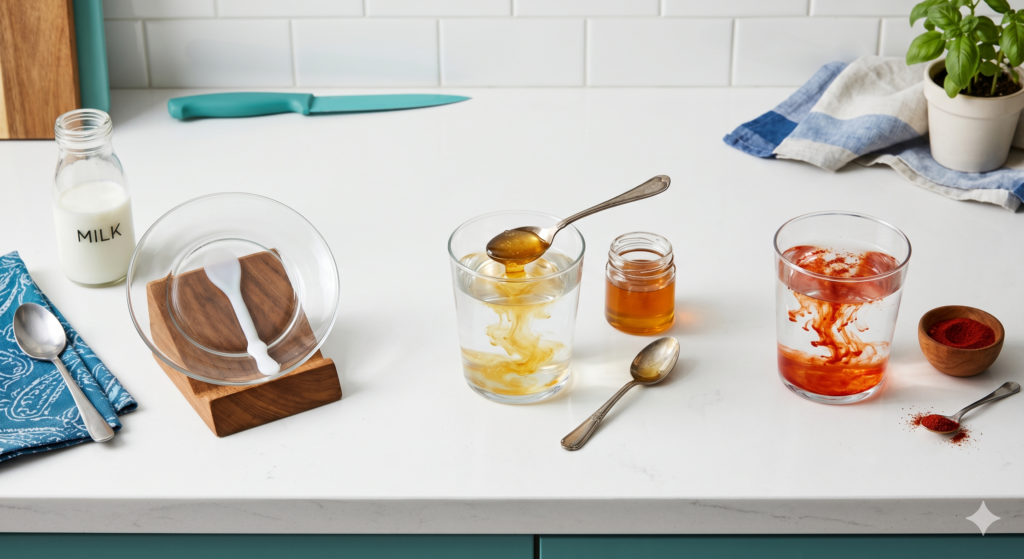
1. Water in milk — the slant test. Put a single drop of milk on a polished, tilted surface (a steel plate or glass). Pure milk flows slowly and leaves a faint white trail behind it. Watered-down milk runs off quickly and leaves no trail.
2. Starch in milk — the iodine test. Add a few drops of iodine (tincture of iodine from your first-aid box) to a little milk. If it turns blue, starch has been added to thicken it.
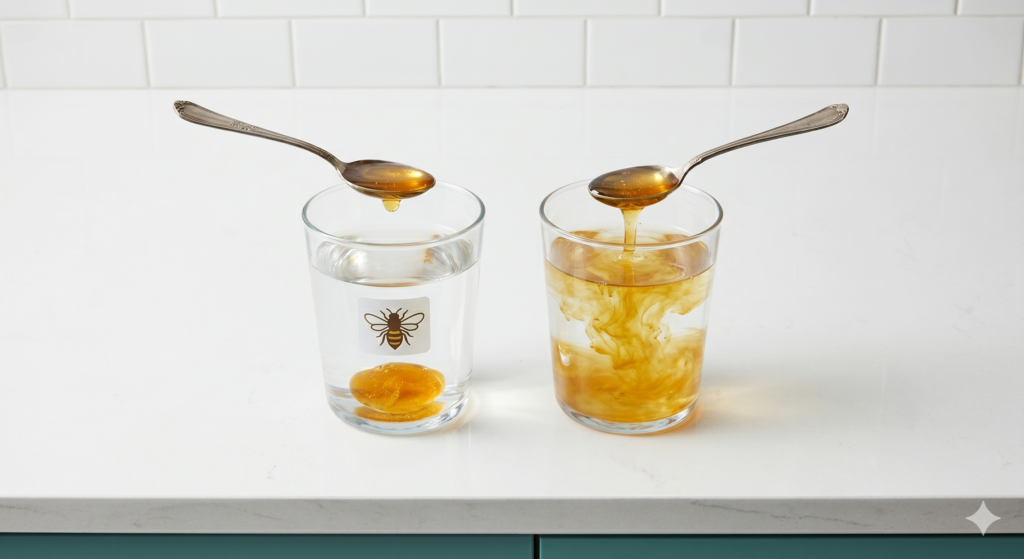
3. Sugar syrup in honey — the water test. Drop a spoonful of honey into a glass of water without stirring. Pure honey is dense — it settles at the bottom as a lump. Adulterated honey disperses and clouds the water.
4. Artificial colour in turmeric or chilli powder — the water test. Sprinkle a spoon of the powder onto a glass of water. Pure powder settles slowly and leaves the water fairly clear. Added dye shows up as bright colour streaks running downward, and brick powder or sand leaves a gritty residue.
5. Papaya seeds in black pepper — the float test. Drop the peppercorns into a glass of water. Real, heavy peppercorns sink. Lighter papaya seeds, stalks and hollow fakes float to the top.
| Food | The quick test | Sign of adulteration |
|---|---|---|
| Milk (water) | Drop on a tilted surface | Runs fast, leaves no white trail |
| Milk (starch) | Add iodine drops | Turns blue |
| Honey | Drop into a glass of water | Disperses instead of settling |
| Turmeric / chilli | Sprinkle on water | Colour streaks or gritty residue |
| Black pepper | Drop into water | Light fakes float to the top |
Get the free printable card — these 5 plus 5 more tests (sugar, tea, coffee and more), ready to stick inside a kitchen cupboard.
What to Do If You Find Adulteration
- Stop using that batch.
- Switch to a licensed brand that shows an FSSAI number on the pack.
- Report it on FSSAI’s “Food Safety Connect” app or its helpline 1800-112-100.
- Keep the packet and bill as evidence.
You can read all the official tests in FSSAI’s DART manual, and learn more on the FSSAI website.
Steal My AI Prompts
Paste into ChatGPT or Claude and swap the [brackets]:
1. Test a specific food safely:
I want to check if my [milk / honey / turmeric / chilli powder] is adulterated.
Give me a safe step-by-step home test using only kitchen items, what a pure vs
adulterated result looks like, and when I should get a lab test instead.
2. Understand the health risk:
Explain in simple terms why [detergent in milk / urea in milk / metanil yellow in
turmeric] is harmful, and what symptoms or long-term effects it can cause.
3. Report it the right way:
Walk me through exactly how to report adulterated food in India step by step,
including the FSSAI app and helpline, and what details and evidence I should keep.
4. Shop smarter:
Give me a short checklist for buying less-adulteration-prone milk, honey and
spices in India - what to look for on the label, packaging, and source.
Helpful Resources & Products
- A home food-adulteration test kit — for quick checks beyond the kitchen tests — [add your Amazon affiliate link]
- A lactometer — a cheap tool to check milk density at home — [add your Amazon affiliate link]
- Tincture of iodine + glass droppers — handy for the starch test — [add your Amazon affiliate link]
Frequently Asked Questions
Are these home tests as reliable as a lab?
No — they’re quick indicators. Validation studies show they’re quite good for spotting things like water and detergent in milk, but for anything serious, confirm with a proper lab or FSSAI.
Is branded, packaged food safer than loose?
A licensed brand with an FSSAI number on the pack is more accountable, which generally lowers risk. Loose or unbranded items carry more risk — but it’s always worth a quick check.
Can these adulterants actually harm me?
Some can. Detergent, urea and industrial dyes like metanil yellow are not food and can cause harm over time. Even “just water” can carry infection if it’s unclean.
Is a little water in milk really a problem?
It cheats you on what you paid for and on nutrition, and dirty water adds an infection risk. The slant test takes seconds, so it’s worth doing.
Where can I see all the official tests?
FSSAI’s DART manual lists over 40 tests across milk, oils, grains, sugar and spices — it’s free to read on the FSSAI website (linked above).