
You’re standing in the supermarket aisle, doing the right thing. You skip the soft drinks and pick the “100% real fruit” juice. You choose the “fruit” yogurt over ice cream, the “high-protein energy bar” over biscuits, and the “health drink” for your kids. You feel good about it.
Here’s the problem: many of these “healthy” choices are quietly loaded with sugar — sometimes more than the junk food you avoided. A single glass of packaged fruit juice can contain your entire recommended daily sugar for the day. The packaging is designed to make you feel healthy, while the ingredients tell a very different story.
The fix isn’t fear — it’s a 10-second skill. Once you know how to read a label, no brand can fool you again. Let’s expose the hidden sugar and give you a method you’ll use for life.
The “Health Halo” Trap
Words on the front of a pack — “natural”, “real fruit”, “no maida”, “energy”, “immunity” — are marketing, not nutrition. They create a “health halo” that makes you assume the product is good for you, so you stop checking. Meanwhile, the actual sugar content sits quietly on the back, where most people never look. The single most powerful health habit you can build is simple: flip the pack over.
How Much Sugar Is Really In There?
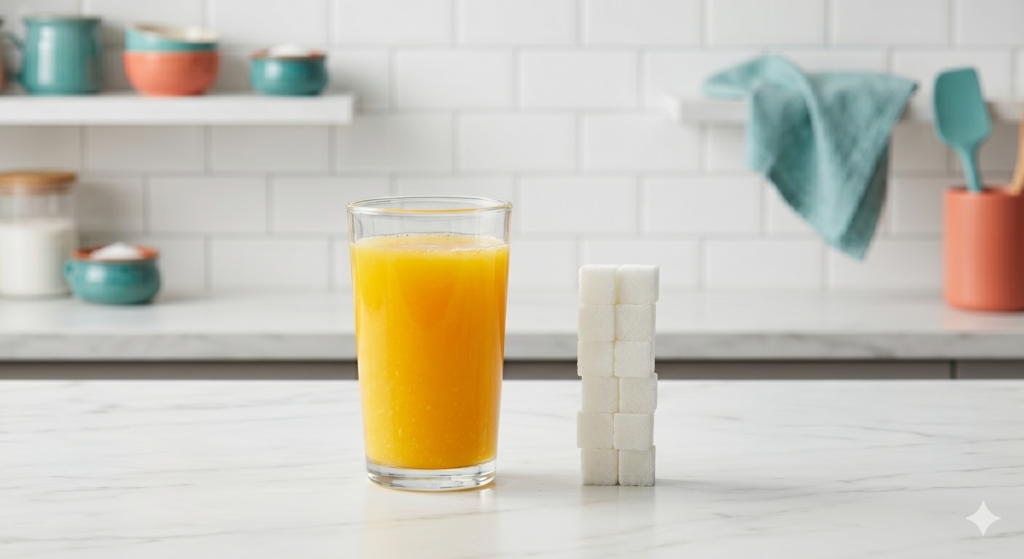
Sugar on labels is written in grams, which feels abstract. So let’s convert it to teaspoons (4 grams = 1 teaspoon) — suddenly it’s very real:
The World Health Organization suggests keeping added sugar under about 6 teaspoons (25g) a day for an adult. As you can see, one glass of “healthy” juice can use up your entire daily budget — before your morning chai, an afternoon biscuit, or any dessert.
The 10-Second Sugar Test
Do this with any packaged food:
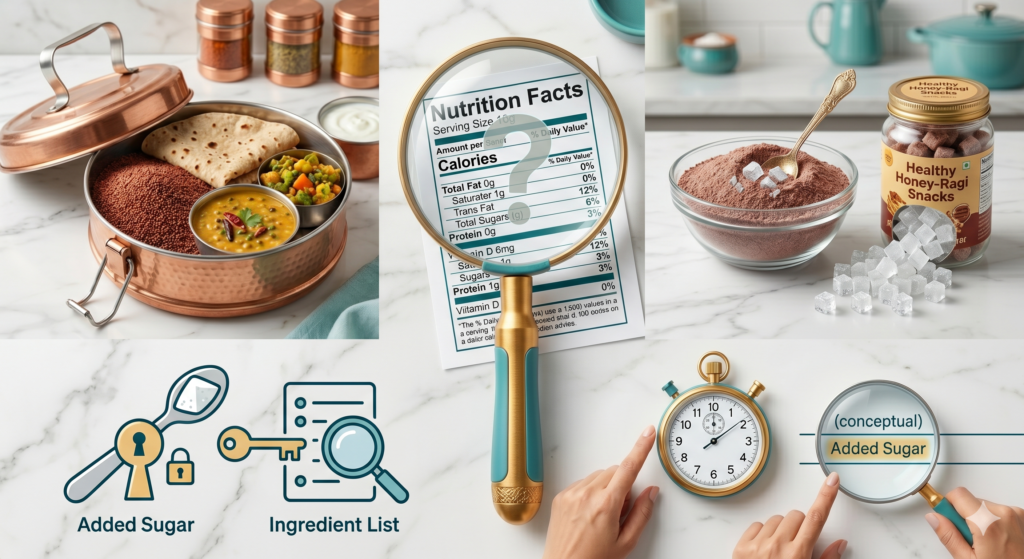
1. Flip it over. Ignore the front; find the nutrition table and ingredients list.
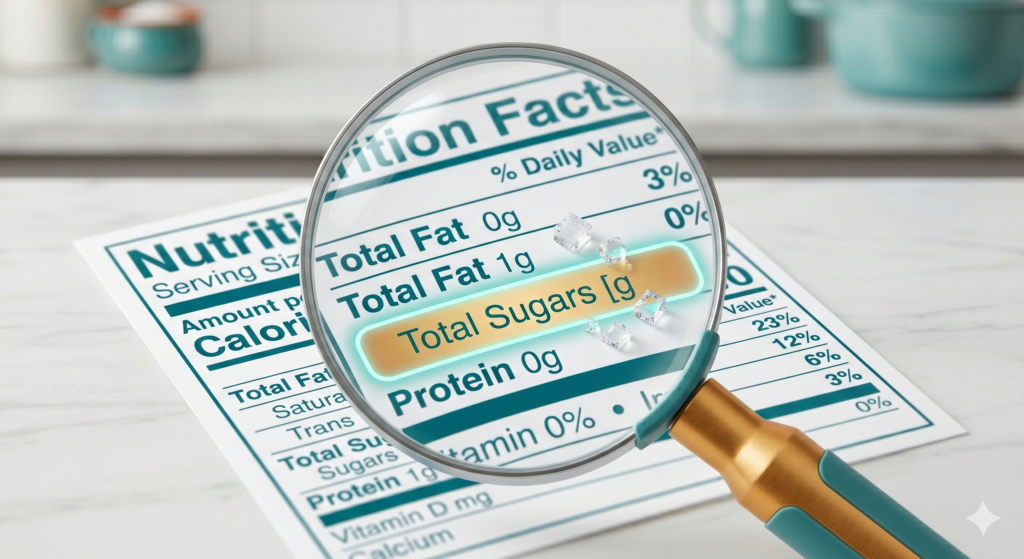
2. Find “Total Sugars” (and “Added Sugars” if it’s listed).
3. Divide the grams by 4. That’s how many teaspoons of sugar you’re eating. 20g? That’s 5 teaspoons.
4. Check the serving size. Brands love to show sugar “per serving” using a tiny, unrealistic serving. If the label says “per 30g” but you’ll eat 90g, multiply the sugar by three.
Sugar’s Many Disguises
Brands also hide sugar by splitting it into several different names, so no single “sugar” looks dominant. If you spot any of these high in the ingredients list — or several of them together — it’s a high-sugar product:
| Sucrose | Glucose | Fructose |
| Dextrose | Maltose | Corn syrup |
| High-fructose corn syrup | Maltodextrin | Cane juice / sugar |
| Invert sugar | Fruit juice concentrate | Molasses |
| Honey | Jaggery | Agave nectar |
| Barley malt | Golden syrup | Rice syrup |
The “first 3 ingredients” rule: ingredients are listed by weight. If any sugar appears in the first three, sugar is one of the main things you’re buying.
Grab the free cheat sheet — the 10-second method, the full list of sugar’s aliases, and a swaps table you can stick on your fridge.
Smarter Swaps That Still Taste Good
You don’t have to give up everything — just trade the worst offenders for nearly-as-easy options:
- Packaged fruit juice → a whole fruit + a glass of water (you get the fibre, not just the sugar).
- Flavoured yogurt → plain curd with fresh chopped fruit.
- Malt “health” drink → plain milk with a pinch of cocoa or haldi.
- Energy/granola bar → a handful of nuts or roasted chana.
- Sweetened muesli/cornflakes → plain oats or poha with fruit.
- Soft drinks → lightly sweetened nimbu paani or chaas.
Steal My AI Prompts
Paste into ChatGPT or Claude and swap the [brackets]:
1. Decode any label instantly:
Here's a food label: [paste the nutrition table + ingredients]. Tell me how many
teaspoons of sugar are in one realistic serving, whether sugar is a main ingredient,
and how this compares to the WHO daily limit of about 6 teaspoons.
2. Audit your kitchen:
Here are the packaged foods in my kitchen: [list them]. Which are likely high in
hidden sugar, and what lower-sugar Indian alternatives would you suggest for each?
3. Build a lower-sugar week:
Plan a simple 7-day lower-sugar routine for an Indian household. Keep meals
familiar and affordable, suggest swaps for our usual sugary items, and don't make
it feel like a punishing diet.
4. Decode the marketing:
Explain what these front-of-pack claims actually mean (and don't mean): "no added
sugar", "sugar-free", "made with real fruit", "natural". What should I still check
on the back of the pack?
Helpful Resources & Products
Trusted reading: the WHO healthy diet guidance on free sugars and India’s own FSSAI / Eat Right India for labelling rules.
- A small kitchen scale — to see what a “real” serving actually is — [add your Amazon affiliate link]
- A fruit-infuser water bottle — a tasty no-sugar swap for juice — [add your Amazon affiliate link]
- Unsweetened snacks (roasted chana, plain nuts, natural peanut butter) — [add your Amazon affiliate link]
Frequently Asked Questions
Is the sugar in whole fruit bad too?
No — whole fruit comes packed with fibre that slows down how the sugar hits your body. The problem is added sugar and juice (where the fibre is removed). Eat the fruit, skip the juice.
Are jaggery and honey healthier than white sugar?
They have trace minerals, but your body still processes them as sugar. Enjoy them, but count them in your daily budget just like sugar.
Can I trust “no added sugar” or “sugar-free” labels?
Not blindly. “No added sugar” can still be high in natural sugars (like juice), and “sugar-free” products may use sweeteners. Always check the Total Sugars line on the back.
How much sugar is okay in a day?
The WHO suggests under about 6 teaspoons (25g) of added sugar a day for adults — and less is better. Children need much less.
Is packaged fruit juice really worse than a soft drink?
They’re often surprisingly similar in sugar. “100% juice” still spikes your sugar fast because it lacks the fibre of whole fruit.