


Updated: June 25, 2026
What’s in this post
- The data: SPIVA, the scorekeeper of this exact debate
- The actual numbers for India
- Why “boring” wins: the math of fees compounding against you
- The honest nuance: this isn’t true everywhere, equally
- What this actually means for your portfolio
- Mini-tool: active vs index decision check
- Free AI prompt: review your own fund choices
- FAQ
There’s a strategy in Indian investing that involves no stock-picking, no market-timing, no chasing last year’s star fund manager, and no excitement whatsoever. You buy a fund that tracks a market index – like the Nifty 50 – and hold it, year after year, doing nothing essentially.
According to the most rigorous, longest-running data available on this exact question, that boring strategy has beaten the large majority of professional, actively managed Indian equity funds — not in one lucky year, but consistently, across multiple time horizons, measured by an independent index provider with no incentive to favour either side.
The data: SPIVA, the scorekeeper of this exact debate
S&P Dow Jones Indices publishes the SPIVA (S&P Indices Versus Active) Scorecard. This long-running, methodologically rigorous report compares actively managed funds against their relevant benchmark indices, across the US, India, and other major markets, going back to 2002 for the original US scorecard.
What makes SPIVA specifically credible, compared to informal claims either side of this debate often makes, is its methodology: it corrects for survivorship bias (many studies quietly ignore funds that closed down during the measurement period, which flatters active management’s track record), uses asset-weighted returns (so larger funds carry appropriate weight, reflecting where investor money actually sits), and matches each fund to the correct, style-appropriate benchmark rather than making unfair comparisons.

The actual numbers for India
The SPIVA India Scorecard for mid-year 2025 found that 89.7% of active large-cap funds in India failed to beat the index over the trailing 5-year period. Separately, multiple analyses citing the same SPIVA data series found that over a full 10-year horizon, roughly 85% of actively managed large-cap funds in India failed to beat the Nifty or Sensex — meaning fewer than 2 in 10 professional fund managers, paid specifically to outperform the market, actually managed to do so over a full decade.
The pattern compounds in fixed income, where it’s arguably even starker: one detailed SPIVA-based analysis found that over 10 years, just 1 of 116 Indian composite bond funds outperformed its index — a 99.1% underperformance rate, the highest recorded across any category measured.
This isn’t a uniquely Indian phenomenon, either — it’s part of a global, decades-long pattern. The same body of SPIVA research shows that after 15 years, “there were no categories in which a majority of active managers outperformed” their benchmark, across domestic equities, international equities, and fixed income combined, in markets around the world.
Why “boring” wins: the math of fees compounding against you
The mechanism isn’t mysterious, and it isn’t really about manager skill at all — it’s structural. As one detailed analysis of the SPIVA data puts it plainly: “a fund charging 80 basis points more than an index fund must beat the index by 0.80% every year just to break even, and that hurdle accumulates relentlessly.”
Active funds typically charge higher fees than index funds, meaningfully covering the cost of research teams, frequent trading, and fund manager compensation — and that fee gap has to be earned back, every single year, before an active fund has even matched the index, let alone beaten it. Over a 20-year horizon, one detailed comparison found that a roughly 1–1.5% annual fee difference compounds into a figure as large as ₹73 lakh lost to fees alone on a substantial long-term investment — money the index fund investor simply keeps, with no additional skill or effort required. This is the same fee-drag mechanism explained in our piece on why your SIP isn’t growing as fast as you think.
The honest nuance: this isn’t true everywhere equally.
A genuinely fair telling of this data has to include where the “boring beats active” pattern is weaker — because the data itself shows this isn’t a uniform rule across every category.
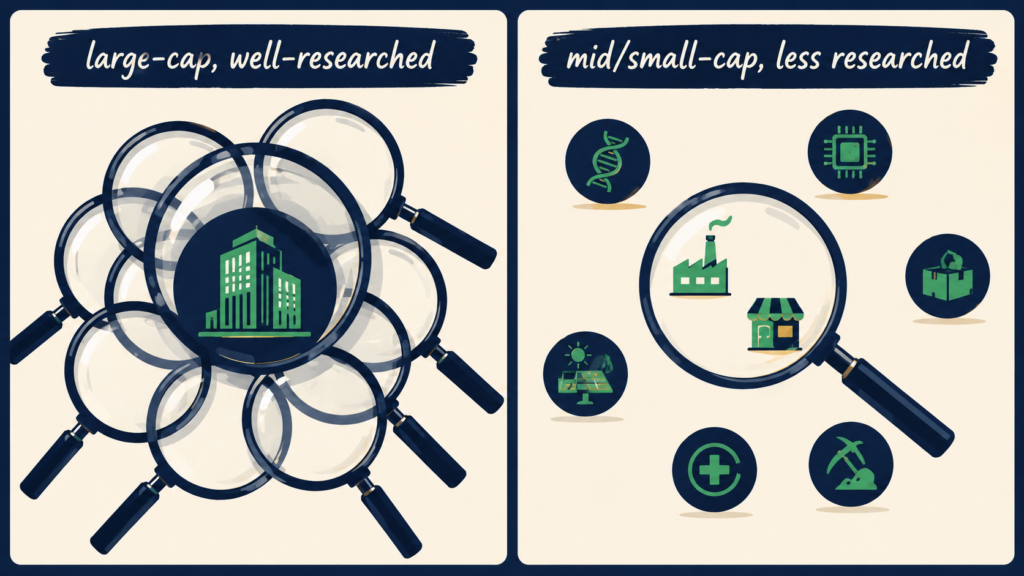
The SPIVA India Year-End 2025 Scorecard specifically noted that “active mid-/small-cap funds delivered a majority outperformance, marking their best relative results since 2014” — a meaningful exception to the large-cap pattern. The reasoning behind this exception is itself instructive: mid- and small-cap stocks are less thoroughly researched and less efficiently priced than the heavily-analyzed large-cap segment, leaving more genuine room for a skilled manager to find a mispriced opportunity before the broader market catches up.
Even India’s ELSS (tax-saving) category showed a different pattern in some years — a Business Standard report on the 2023 SPIVA data found that 70% of Indian ELSS funds outperformed their benchmark across all measured time horizons that year, the only equity category to do so. The picture, in other words, isn’t “active management is always useless” — it’s “active management’s edge, where it exists at all, is concentrated in less efficient corners of the market, while it consistently struggles in the most thoroughly analysed segment: large-cap equity.”
What this actually means for your portfolio
The evidence-based, non-hyped conclusion most closely matching what the data actually shows: for broad large-cap Indian equity exposure — the core, foundational part of most portfolios — a low-cost index fund has a strong, persistent, multi-decade statistical edge over the average actively managed alternative, purely because so few active managers clear the fee hurdle required just to match the index, let alone beat it.
For mid-cap and small-cap exposure, where markets are measurably less efficient, the case for paying for genuine active skill is more defensible — though even there, the manager’s specific track record and consistency (not last year’s headline return) matters far more than most investors check. If you’re just starting to build a portfolio and want a concrete starting point, our step-by-step guide to investing your first ₹10,000 in India walks through exactly this large-cap-index-first approach.
Mini-tool: active vs index decision check
Quick Decision Guide
| Exposure type | What the data suggests |
|---|---|
| Large-cap Indian equity (core holding) | Strong case for low-cost index fund |
| Mid-cap / small-cap equity | Active management has a more defensible case — check manager’s specific track record |
| ELSS / tax-saving funds | Historically mixed — check recent SPIVA data before choosing |
| Fixed income / bond funds | Very strong case for index/passive approach |
Free AI prompt: review your own fund choices
Act as a financial-literacy assistant (not a SEBI-registered advisor — for education only). I currently hold these mutual funds: [list your funds, or describe "I have a mix of large-cap and mid-cap active funds"].

Based on what's known about SPIVA India data (active large-cap funds underperforming indices ~85-90% of the time over 5-10 years, while mid/small-cap active funds have shown some recent outperformance):
1. For each fund category I hold, tell me whether the data generally favors active or index/passive approaches
2. Suggest specific questions I should research about my own funds' expense ratios and historical performance versus their benchmark
3. Do NOT recommend specific funds to buy — just help me think through the active-vs-index question for my existing holdings
FAQ
Does “boring beats active” mean I should never use an active fund?
No — the data specifically shows mid-cap, small-cap, and some periods of ELSS funds have favored active management, so the conclusion is segment-specific, not a blanket rule against all active funds.
How do I know if my specific active fund is one of the rare outperformers?
Compare its actual historical returns against its correct benchmark index (not just “the market” generally) over at least 5-10 years, and check whether that outperformance has been consistent rather than driven by one unusually good year.
Is SPIVA data biased toward passive investing since S&P also sells indices?
SPIVA’s methodology (correcting for survivorship bias, asset-weighting, proper benchmark matching) is widely regarded as rigorous and is frequently cited by both passive and active investing researchers, though it’s fair to note S&P does have index-related business interests.
What’s a simple first step if I want to shift toward index funds?
Start by checking your current large-cap fund holdings against their benchmark’s actual return over 5-10 years — if it has consistently underperformed, that’s a concrete, fund-specific reason to consider an index fund alternative for that allocation.
About the author
Lokesh Goyal is the founder of digmod.com, digmonster.com, and instantbundles.com. He writes about Indian-context business, finance, AI, and digital life. By day he teaches computer science in a government school in Punjab.