


Updated: June 2026
The Default-Regime Trap
Since the new tax regime became the default option for salaried individuals, a large number of employees simply never revisit the choice — payroll software picks a regime, the deduction shows up on the payslip, and that’s the end of the conversation. For someone with no major deductions, the new regime’s lower slab rates can genuinely be the better deal. But for someone with significant HRA, an active home loan, or meaningful 80C investments (PPF, ELSS, life insurance, EPF contributions), staying on the new regime by default — rather than by an actual comparison — can mean paying noticeably more tax than necessary, every single year.
This isn’t a loophole or aggressive tax planning. It’s simply running both numbers, which most salaried employees never do because their employer’s payroll system already “decided” for them.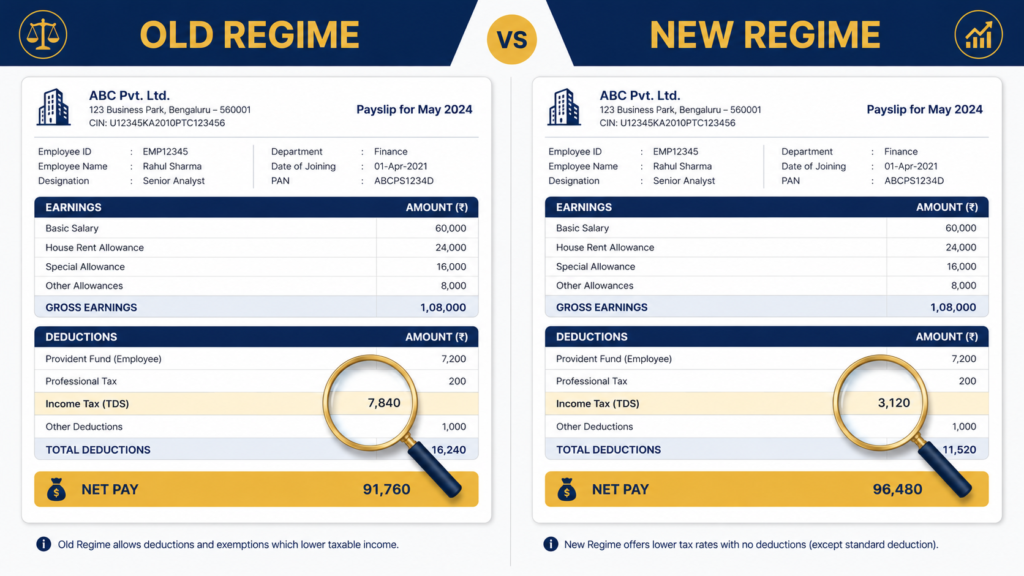
Old Regime vs. New Regime, in Plain Terms
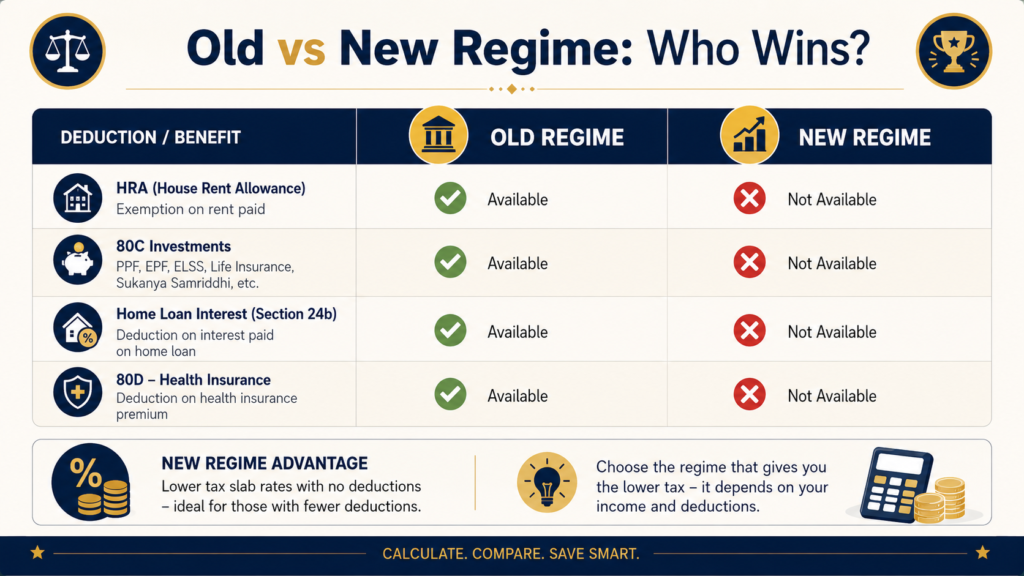
The old regime has higher slab rates but allows a long list of deductions and exemptions — HRA, 80C investments up to ₹1.5 lakh, home loan interest, 80D health insurance premiums, and several others. The new regime has lower slab rates but strips away nearly all of these deductions in exchange for that simplicity.
The math only favors one regime over the other once you actually plug in your specific numbers — there’s no universal “better” choice. Someone renting in a metro city with a large HRA component and an active ELSS SIP often does better under the old regime. Someone with no rent, no loans, and minimal voluntary investments often does better under the new regime’s lower rates.
Who Actually Loses Out by Not Comparing
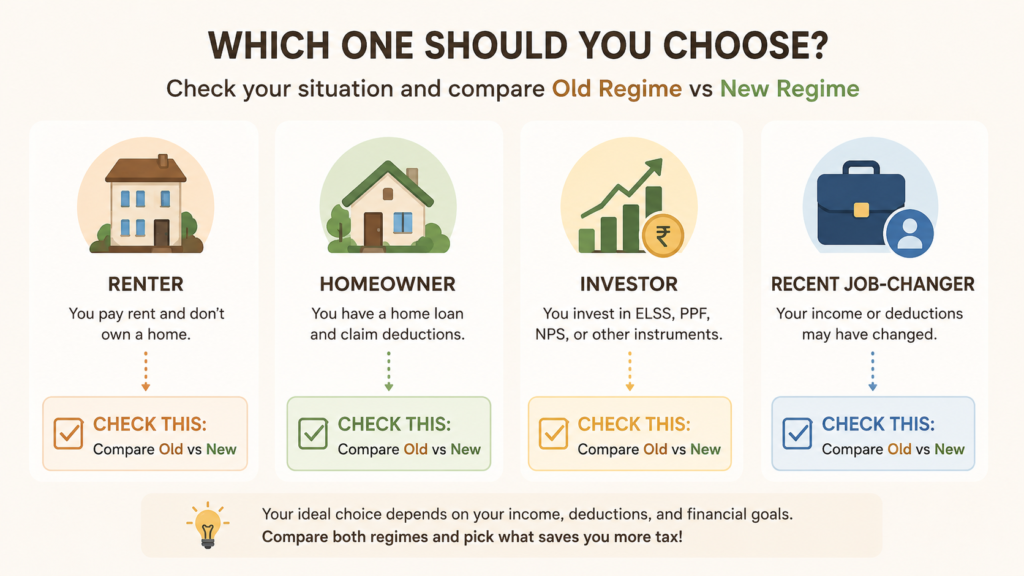
The people most likely to be quietly overpaying are usually one or more of the following:
- Renters claiming HRA who never compared what that exemption is worth under the old regime versus what they’d save in slab rates under the new one.
- Anyone with an active home loan where the interest deduction (up to ₹2 lakh under Section 24) can be substantial and is unavailable under the new regime.
- People maxing out 80C through PPF, ELSS, or life insurance, who assume the new regime’s lower rates automatically beat the deduction value without checking.
- Anyone who changed jobs or had a salary jump recently, since the regime that made sense at a lower salary may no longer be optimal at a higher one.

A Simplified Worked Example
Consider someone earning ₹12 lakh annually who pays ₹15,000 monthly rent (₹1.8 lakh/year, partially eligible for HRA), invests ₹1.5 lakh in 80C instruments, and pays ₹25,000 in health insurance premiums (80D). Under the old regime, these deductions could meaningfully reduce taxable income before slab rates even apply. Under the new regime, none of these deductions count, but the slab rates themselves are lower across most brackets.
The honest answer for this exact profile depends on current-year slab numbers, which change with each Union Budget — which is precisely why this post avoids quoting specific rupee savings and instead points to the official calculator. The pattern that holds steady year to year, though, is this: more deductions generally tilt the math toward the old regime, and fewer deductions tilt it toward the new one.
Quick Regime Comparator
This is a simplified self-check to flag whether a full comparison is worth your time — not a substitute for an actual tax calculation with your real numbers.
🛠️ Mini-Tool: Should You Even Bother Comparing?
Tick every box that applies to you.
| ☐ | I pay rent and could claim HRA |
| ☐ | I have an active home loan with significant interest paid annually |
| ☐ | I invest ₹50,000+ annually in 80C instruments (PPF, ELSS, insurance) |
| ☐ | I pay health insurance premiums for myself or parents (80D) |
| ☐ | I’ve never actually run both regime calculations side by side |
Reading your result: 1+ ticks in the first four rows means a real comparison is worth doing — the savings can be meaningful. If you ticked the last row too, you’re very likely on a default regime you’ve never actually verified.
How to Actually Check Which Is Better for You
- Gather your real numbers: annual rent paid, home loan interest certificate, total 80C investments, health insurance premiums.
- Use the official Income Tax Department’s regime comparison calculator (available on the incometax.gov.in portal) — it’s free and uses current official slab rates.
- Re-run this every year, not just once — a salary increase, a new home loan, or a lapsed insurance policy can flip which regime is better.
- Inform your employer’s payroll team explicitly if you want to switch regimes — most companies allow a declaration at the start of the financial year.
If you’re early in your investing journey and want to understand where 80C investments like ELSS and PPF fit into a broader plan, our guide on investing your first ₹10,000 in India covers the foundational instruments this tax comparison depends on.
“My annual salary is ₹[amount], I pay ₹[amount] in rent annually, I have [home loan interest amount, if any], and I invest ₹[amount] annually in 80C instruments (PPF/ELSS/insurance). Based on the current Indian income tax slab structure for old vs. new tax regime, walk me through which regime would likely save me more tax, and explain the calculation step by step so I can verify it on the official income tax calculator myself.”
FAQ
Q1: Can I switch tax regimes every year?
Salaried individuals with no business income can generally choose their preferred regime each financial year when filing returns, though employer payroll declarations may need to be updated separately.
Q2: Is the new regime always simpler but worse for savings?
Not always — for people with few deductions, the new regime’s lower slab rates can result in genuinely lower tax. It depends entirely on your specific deduction profile.
Q3: Does my employer automatically pick the better regime for me?
No — payroll systems typically apply a default (usually the new regime) unless you explicitly submit a declaration choosing otherwise.
Q4: Where can I find the official, most current calculator?
The Income Tax Department’s official portal (incometax.gov.in) hosts a regime comparison calculator that reflects the current year’s rules — always use the official source rather than third-party estimates for filing decisions.
- Income Tax Department of India (incometax.gov.in) — official old vs. new regime rules and calculator
- Central Board of Direct Taxes (CBDT) — circulars on tax regime defaults for salaried employees
- Ministry of Finance, Government of India — Union Budget tax slab announcements
We research publicly available tax information and cite primary sources so you can verify everything yourself. We are not chartered accountants — always confirm with a tax professional before filing.