
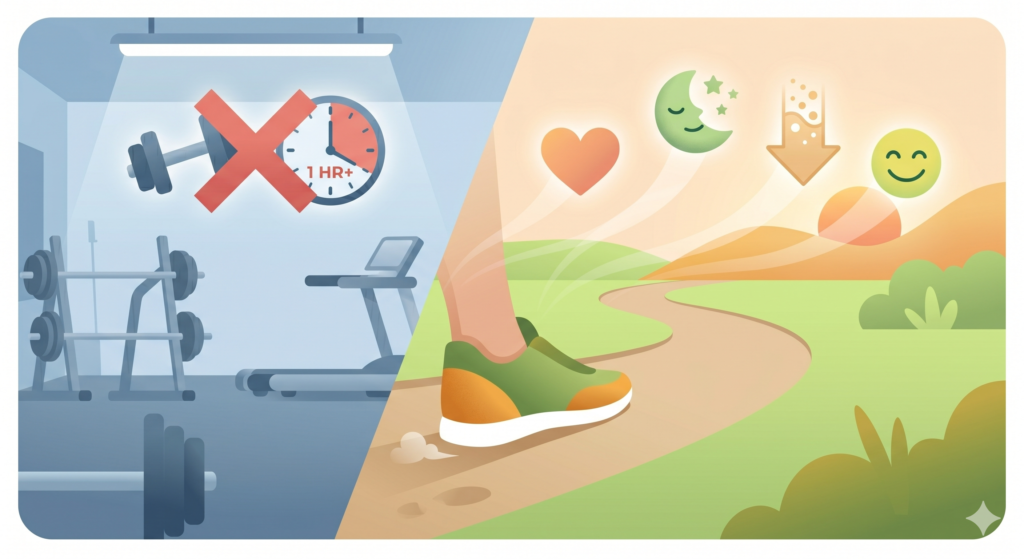

Be honest: how’s that gym membership going? If you’re like most people, you paid for the year, went enthusiastically for three weeks, and now the card mostly lives in your wallet as a small monument to guilt.
Here’s the liberating truth — for a huge chunk of the everyday health benefits you actually care about, you don’t need the gym at all. You need a 15-minute walk after dinner. It’s free, it’s gentle, it fits any schedule, and the science behind it is genuinely impressive — especially for something so easy.
This isn’t anti-gym (lifting weights is brilliant for strength). It’s pro-consistency. The simple walk you’ll actually do every day beats the intense workout you keep skipping. Let’s look at why this little habit punches so far above its weight.

The Magic Window Right After You Eat
When you eat, your blood sugar rises. Sit on the sofa, and it spikes high, then crashes — leaving you sluggish. But if you take a gentle walk, your muscles pull that sugar out of your blood to use as fuel, and the spike flattens. Researchers can see it clearly:
In a 2025 study, a short 10-minute walk after eating produced a noticeably lower blood sugar peak than sitting still did. And in a 2017 Indian trial, walking for 15 minutes after each meal controlled blood sugar better than a single 45-minute morning walk. The timing is the secret weapon — small movement at the right moment beats a big effort at the wrong one.
It’s Not Just About Blood Sugar
That same little walk quietly does a lot more:
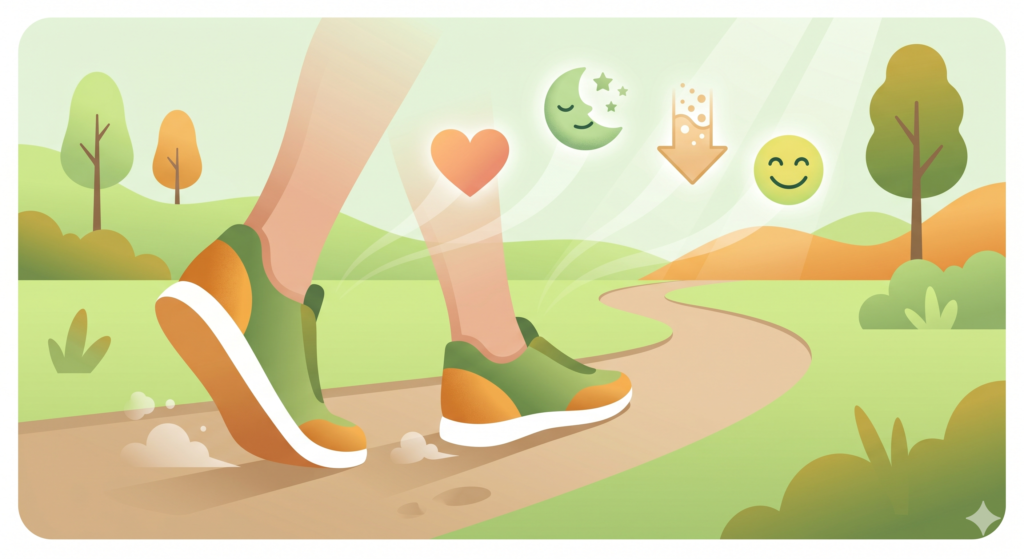
- Better digestion — gentle movement helps food move along and eases that heavy, bloated feeling.
- Calmer sleep — a relaxed evening walk helps you wind down better than scrolling on the sofa.
- Mood lift — light activity and fresh air reduce stress and clear your head.
- Heart health — regular easy walking supports blood pressure and circulation.
- Kind to joints — unlike intense workouts, a stroll is something almost anyone can do daily.
“But Isn’t the Gym Better Exercise?”
Fair question — and yes, for building strength and serious fitness, structured training (weights, cardio) does things a walk can’t. If you love the gym and go consistently, wonderful; keep it up, and add the post-meal walk on top.
But for most people the real choice isn’t “gym vs walk” — it’s “gym I keep skipping vs walk I’ll actually do.” A habit you sustain for years quietly beats an intense plan you abandon in a month. The after-dinner walk wins because you’ll actually do it.
How to Start Tonight
No plan, no equipment, no excuses:
- Start with 10 minutes. The goal is to begin, not to impress anyone.
- Walk within 10–15 minutes of finishing your meal — that’s the magic window.
- Keep it gentle. A relaxed pace where you can still chat is perfect.
- Begin after your heaviest meal (usually dinner), then build to other meals.
And for every reason you’ll invent to skip it, there’s an easy fix:
| “But…” | The fix |
|---|---|
| “I’m too tired” | Even 5 minutes counts — start there, you’ll often keep going. |
| “No time” | Walk while you take a phone call, or around the house. |
| “Too hot / monsoon” | Pace indoors, walk on the terrace, or stroll a nearby mall. |
| “Streets unsafe at night” | Walk in your lane with family or indoors in a place. |
| “My knees hurt” | Slow, flat route and supportive shoes; check with a doctor. |
Grab the free starter guide — why it works, a 4-week ramp, and no-excuse fixes, on one page.
Steal My AI Prompts
Paste into ChatGPT or Claude and swap the [brackets]:
1. Build a routine around your life:
Help me build a realistic post-meal walking routine. My daily schedule is
[describe], my meal times are [describe], and my fitness level is [beginner/etc].
Suggest when and how long to walk, and how to build the habit so it sticks.
2. Beat the weather:
Give me practical indoor walking options for when it's too hot or raining in
[your city]. I want simple ways to get 10-15 minutes of gentle movement at home
after meals.
3. Habit-stack it so you don’t forget:
Suggest 5 ways to "habit-stack" a short after-dinner walk onto things I already do
every evening, so it becomes automatic and I don't have to rely on willpower.
4. Make it gentle on the body:
I'm a beginner with [knee pain / extra weight / am out of shape]. Give me a very
gentle, safe way to start walking after meals, and signs that mean I should slow
down or check with a doctor.
Helpful Resources & Products
Trusted reading: this 2025 study on a 10-minute post-meal walk and its effect on blood sugar.
- A comfortable pair of walking shoes — the only “equipment” you need — [add your Amazon affiliate link]
- A simple step tracker/fitness band — to make the habit satisfying — [add your Amazon affiliate link]
- Cushioned insoles or walking socks — for happier feet and knees — [add your Amazon affiliate link]
Frequently Asked Questions
How long and how soon should I walk?
Aim for 10–15 minutes, starting within about 10–15 minutes of finishing your meal. That post-meal window is when it helps your blood sugar most.
How fast should I go?
Gentle is fine — a relaxed, conversational pace works. You don’t need to sweat or get out of breath for the blood-sugar benefit.
Does this really beat the gym?
For strength and peak fitness, no — proper training does more. But for everyday health and the simple fact that you’ll keep doing it, a daily walk often delivers more real-world benefit than a gym plan you abandon.
What if I can’t walk right after dinner?
A walk a bit later still helps and is far better than none. Do what fits your evening — consistency matters more than perfect timing.
I have diabetes — is a walk enough?
Post-meal walks are a helpful habit and many people with diabetes benefit, but they don’t replace your treatment. Follow your doctor’s plan and use walking as a support, not a substitute.