


Updated: June 2026
Why Budgeting Apps Quietly Fail Most People
Budgeting apps ask you to do something most people abandon within weeks: manually categorize every transaction, review dashboards regularly, and stay motivated by tracking alone. The apps aren’t badly designed — the problem is that tracking requires ongoing willpower, and willpower is exactly the resource that’s lowest right when money stress is highest.
A 4-account system flips this entirely. Instead of tracking spending after the fact, it physically separates money by purpose before you can spend it on the wrong thing — the discipline is baked into the structure, not dependent on you remembering to check an app every day.
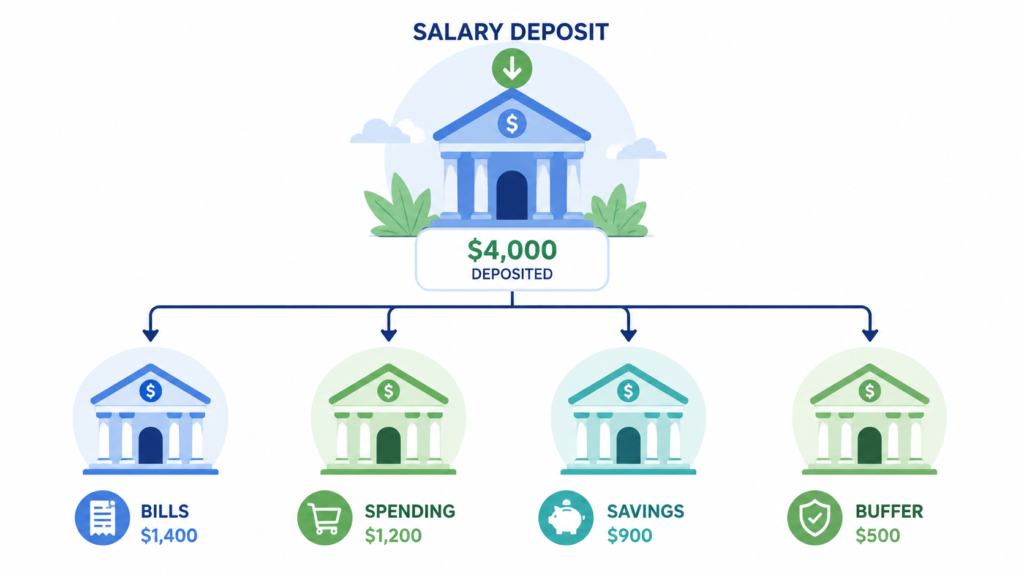
The 4 Accounts, Explained
- Bills Account: Rent, utilities, EMIs, insurance premiums, subscriptions — every fixed, recurring obligation. Nothing discretionary touches this account.
- Spending Account: Groceries, eating out, entertainment, shopping — everyday discretionary money. This is the only account you spend freely from day to day.
- Savings/Investing Account: SIPs, PPF contributions, any money moving toward long-term goals. Money here is meant to leave this account only into investments, never back into daily spending.
- Buffer Account: A small cushion for irregular but predictable costs — annual insurance renewals, festival spending, an occasional larger purchase — so these don’t wreck your Spending account when they show up.
The key mechanism is that your salary lands in one place and gets split automatically (or manually, right after payday) into these four — after that, each account’s purpose is fixed, so you never have to ask “can I afford this?” by checking your total bank balance; you check the relevant account instead.
A Starting Split You Can Adjust
There’s no universal percentage that works for everyone, but a reasonable starting point for many salaried Indians looks like this: 50% Bills, 30% spending, 15% savings/investing, and 5% buffer. Someone with a home loan or high rent will naturally need a larger Bills share; someone debt-free with strong savings goals might shift more toward savings/investing.
Calculate Your Own 4-Account Split
Use this to translate the percentages into actual rupee amounts based on your take-home salary.
🛠️ Mini-Tool: 4-Account Split Calculator
Example based on a ₹50,000/month take-home salary — substitute your own number and recalculate the same way.
| Account | % (starting point) | Amount (on ₹50,000) |
|---|---|---|
| Bills | 50% | ₹25,000 |
| Spending | 30% | ₹15,000 |
| Savings/Investing | 15% | ₹7,500 |
| Buffer | 5% | ₹2,500 |
To use your own number: multiply your take-home salary by each percentage (e.g., salary × 0.50 for Bills) and round to a convenient figure for easy automated transfers.
Why Friction Beats Willpower for Money Habits
Most personal finance advice quietly assumes you’ll remember your budget at the exact moment you’re standing in a shop deciding whether to buy something. In practice, that’s the worst possible moment to rely on memory or willpower — you’re tired, distracted, or emotionally invested in the purchase, and a mental budget loses to an actual desire almost every time.
Physical account separation sidesteps this entirely. If your Spending account genuinely doesn’t have enough money left for a purchase, no amount of willpower is needed — the decision is already made by the structure, not by you in a vulnerable moment. This is the same principle behind why automated SIPs survive market dips better than manual investing decisions: removing yourself from the in-the-moment choice is more reliable than strengthening your resolve.
3 Mistakes That Undo the System
- Using one debit card linked to all accounts. If your card can pull from Bills or Savings as easily as Spending, the friction the system relies on disappears. Carry only the Spending account’s card day-to-day.
- “Borrowing” from Savings during a tight month. One transfer back into Spending tends to become a pattern — if Bills or Spending genuinely runs short, that’s a signal to revisit your percentages, not to raid Savings as a quiet workaround.
- Skipping the Buffer account because it feels small. Even ₹2,000-3,000 a month adds up to a meaningful cushion within a year, and it’s specifically what prevents one annual expense from derailing the whole system.
How to Actually Set This Up
- Open 3 additional savings accounts at your existing bank (most Indian banks allow multiple free savings accounts) or use a separate bank entirely for Savings/Investing to add a small psychological barrier against dipping into it.
- Set up automated transfers for the day after salary credit — most banks support standing instructions, removing the need to manually move money each month.
- Link your SIP auto-debit to the Savings/Investing account specifically, not your main salary account, so investing happens before you ever see that money as “available.”
- Review the split only once or twice a year, not monthly — the system is designed to remove ongoing decision-making, not add a new tracking habit.
This pairs naturally with the discipline-by-structure approach in the boring investment strategy that beats 90% of active traders — automating the Savings/Investing account is what makes that strategy actually stick long-term.
If you’re also building an additional income stream to feed into this system, our piece on Indians training the robots that will replace them explores one of the more unusual emerging income paths worth knowing about.
A printable one-page worksheet to calculate your own split, list your account numbers for quick reference, and track your first 3 months of automated transfers. No email required.
“My monthly take-home salary is ₹[amount]. My fixed monthly obligations (rent, EMIs, insurance, subscriptions) total roughly ₹[amount]. Based on the 4-account budgeting system (Bills, Spending, Savings/Investing, Buffer), suggest a realistic percentage split for my situation and calculate the exact rupee amount for each account.”
FAQ
Q1: Do I need 4 separate banks, or can they be in one bank?
Separate banks add a small psychological barrier against impulsively moving money between accounts, but multiple accounts within one bank work too if that’s more convenient.
Q2: What if an unexpected expense exceeds my Buffer account?
That’s a sign your Buffer percentage may be too small for your situation — adjust it upward at your next periodic review rather than constantly borrowing from Savings.
Q3: Should bonuses or irregular income go through this same split?
Many people apply a heavier weighting toward Savings/Investing for windfalls specifically, since that money wasn’t already budgeted into the regular split.
Q4: How is this different from a budgeting app’s “envelope” categories?
The core difference is enforcement — app categories are just labels you can override anytime, while separate bank accounts create actual friction against spending money outside its intended purpose.
- Reserve Bank of India (RBI) — guidelines on multiple savings account regulations
- Journal of Consumer Research — research on mental accounting and budgeting behavior
- National Centre for Financial Education (India) — personal budgeting framework guidance
We research publicly available financial guidance and cite primary sources so you can verify everything yourself. We are not financial advisors — always consult a qualified professional for personalized budgeting advice.