


Updated: June 2026
The Promise vs. the Reality
“Buy the dip” is one of the most repeated pieces of market wisdom, and the underlying logic is genuinely sound — buying assets when they’re temporarily cheaper than their long-term value is a reasonable strategy in theory. The problem isn’t the idea. It’s that almost nobody can execute it consistently in real time, because a market dip doesn’t announce itself as “this is the bottom, buy now” — it announces itself as falling prices, bad news headlines, and genuine uncertainty about whether it will fall further.
By the time most retail investors feel confident enough to act, the “dip” has often already partially recovered, meaning they’re buying at a worse price than if they’d simply stayed invested the whole time.
Why “Buy the Dip” Fails in Practice
Several behavioral patterns consistently undermine this strategy for retail investors:
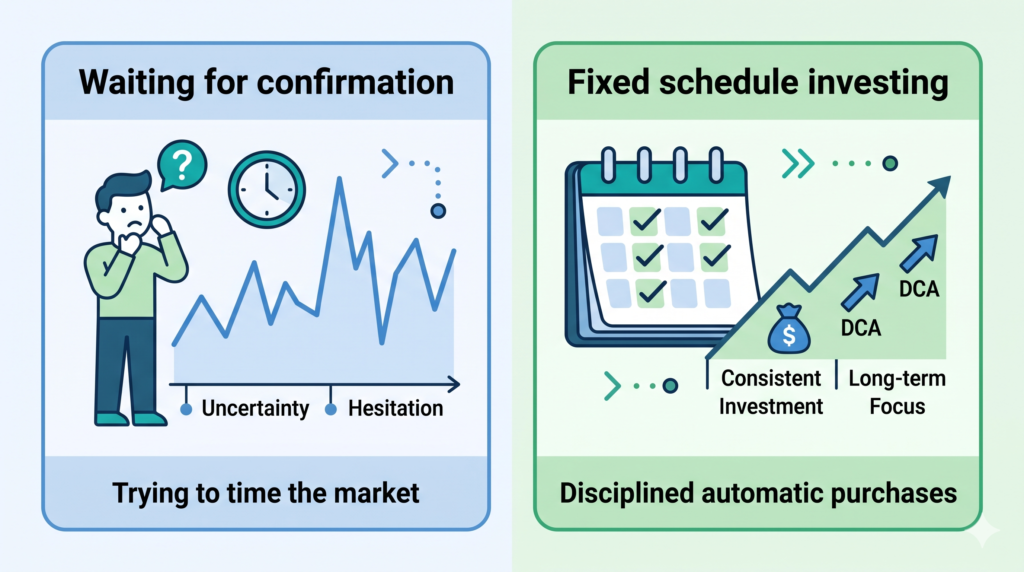
- Waiting for the “real” bottom: Since nobody can identify a bottom in real time, investors keep waiting for confirmation that never arrives until prices have already moved up.
- Not having cash ready: Many investors are already fully invested when a dip happens, meaning “buying the dip” would require selling something else first — an extra decision that rarely gets made under pressure.
- Confusing a dip with a larger downtrend: Not every drop is a buying opportunity; some are the start of a longer decline, and retail investors often can’t tell the difference until well after the fact.
- Letting one missed dip create hesitation on the next one: A failed attempt to time one dip often makes investors more cautious and slower to act on the next, compounding the timing problem over years.
What History Actually Shows About Dips
Looking back at major Indian equity market corrections over the past two decades — including the 2008 financial crisis, the 2020 pandemic crash, and several smaller corrections in between — a consistent pattern emerges: the sharpest portion of each recovery tends to happen in a relatively short window right after the bottom, often before broader sentiment has shifted from fear to optimism. Investors who stayed mechanically invested through the decline captured that early recovery; those waiting for confirming good news typically entered after the steepest gains had already passed.
This doesn’t mean every dip recovers quickly or fully — markets can stay depressed for extended periods, and some downturns are genuinely structural rather than temporary. But the pattern of “the recovery starts before it feels safe” has held often enough that it’s a primary reason systematic, schedule-based investing tends to outperform discretionary dip-timing for individual investors over long horizons.
The Confirmation Trap, Explained
The core psychological issue is what behavioral finance researchers call the need for confirmation before acting — investors want some signal that the worst is over before committing money, but markets typically recover before any such signal is obvious. By the time headlines shift from “markets in turmoil” to “markets recovering,” a meaningful portion of the recovery has often already happened.
This is part of why the boring investment strategy that beats 90% of active traders tends to outperform dip-timing attempts — it removes the confirmation requirement entirely by investing on a fixed schedule regardless of recent price action.
Are You an Emotional Investor? Quick Self-Check
This is a behavioral reflection, not a financial assessment — it’s meant to surface patterns worth noticing in your own investing habits.
🛠️ Mini-Tool: Emotional Investing Risk Score
Tick every statement that’s true for you.
| ☐ | I’ve waited for a market dip to “feel safer” before investing, and missed buying lower |
| ☐ | I check market news daily during periods of volatility |
| ☐ | I’ve held cash “waiting for the right moment” for more than 3 months |
| ☐ | A past missed dip makes me hesitant to act on the next one |
| ☐ | I don’t have a fixed, automated investing schedule |
Reading your score: 0–1 ticks suggests relatively disciplined habits. 2–3 suggests some timing-driven tendencies worth addressing. 4+ suggests dip-timing is likely costing you more than it’s helping — automation would probably serve you better.
What Actually Works Instead
- Automate contributions on a fixed schedule (weekly or monthly), regardless of recent price movement — this removes the confirmation-waiting problem entirely.
- Keep a small, pre-decided “dip fund” separate from your main SIP, with clear rules written in advance for when you’ll deploy it (e.g., “invest this fund only if the index falls 15%+ from its recent high”), so the decision isn’t made emotionally in the moment.
- Limit how often you check market news during volatility — most of the emotional pressure to time the market comes from frequent exposure to alarming headlines, not from the price movement itself.
- Accept that missing some dips is the cost of avoiding worse mistakes — the goal isn’t perfect timing, it’s avoiding the bigger error of long stretches of uninvested cash.
If you’re building this kind of structure from scratch, our guide on investing your first ₹10,000 in India covers how to set up the automated foundation this approach depends on.
“I tend to [describe your pattern — e.g., wait for dips to feel confirmed before investing, hold cash during volatility, check market news frequently]. Based on general behavioral finance principles, help me design a simple pre-committed rule (written in if-then form) that would remove emotional decision-making from my investing, so I don’t need to time the market manually.”
FAQ
Q1: Is “buy the dip” a bad strategy entirely?
The underlying logic is sound, but consistent execution by individual investors is the real challenge — pre-committed rules tend to outperform in-the-moment decisions.
Q2: How do professional investors handle this differently?
Many institutional strategies use systematic, rules-based triggers rather than discretionary judgment calls, precisely to avoid the confirmation-waiting problem retail investors face.
Q3: Is holding cash for opportunities ever a good idea?
A small, clearly defined allocation with pre-set rules can make sense; indefinitely holding large cash reserves “waiting for the right moment” usually costs more in missed growth than it saves.
Q4: Does this apply to individual stocks too, or just index funds?
The same behavioral pattern applies broadly, though individual stock dips carry additional company-specific risk that index-level dips don’t.
- Journal of Behavioral Finance — research on investor timing behavior during market corrections
- Securities and Exchange Board of India (SEBI) — investor behavior and market participation studies
- Association of Mutual Funds in India (AMFI) — retail investor flow data during market volatility
We research publicly available financial and behavioral data and cite primary sources so you can verify everything yourself. We are not SEBI-registered advisors — always consult a qualified professional for personalized investment advice.