


How productive would you be if you had no phone for one day?
Most people either feel immediately anxious at the question — or start listing all the work things they “couldn’t do” without it. Both responses are revealing.
The Pomodoro Technique isn’t about putting away your phone. It’s about something far more fundamental: reclaiming your ability to focus deeply in a world specifically engineered to prevent it.
And it works — with some important Indian-context adaptations.
What the Pomodoro Technique Is
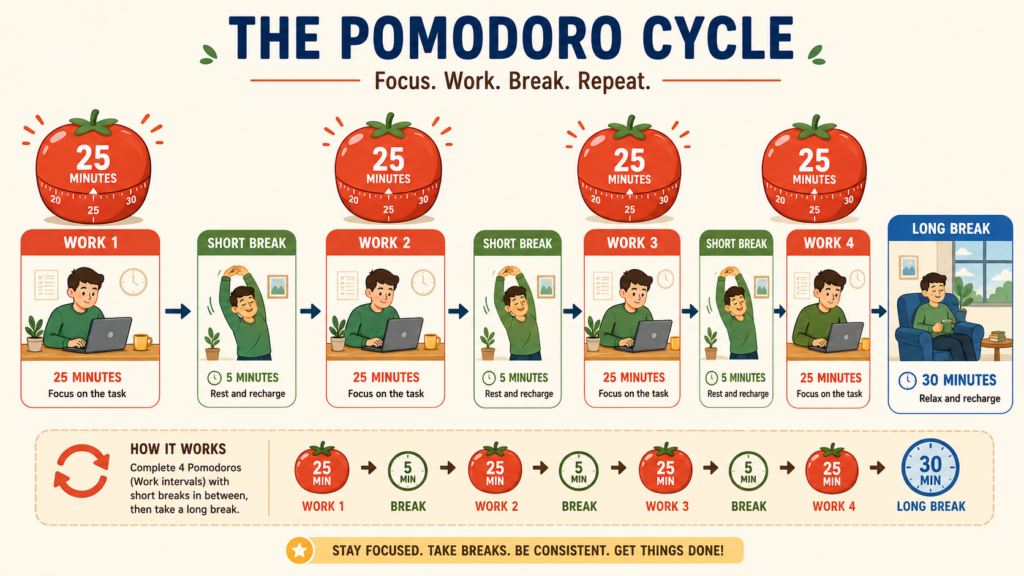
Created by Francesco Cirillo in the late 1980s, the Pomodoro Technique is disarmingly simple:
- Choose ONE task to work on
- Set a timer for 25 minutes (one “pomodoro”)
- Work with complete focus until the timer rings — no phone, no email, no multitasking
- Take a 5-minute break
- Repeat 4 times
- After 4 pomodoros, take a 25–30 minute break
Why It Works (The Neuroscience)
| Mechanism | Why It Works |
|---|---|
| Time-boxed urgency | The ticking timer creates mild time pressure — enough to overcome initiation resistance. 25 minutes feels manageable. |
| Forced single-tasking | Multitasking reduces productivity by 40% and increases errors by 50% (University of Michigan). Pomodoro enforces one task. |
| Structured rest | Your prefrontal cortex depletes like a battery. Forced breaks recharge it and prevent decision fatigue. |
Indian Context Adaptations
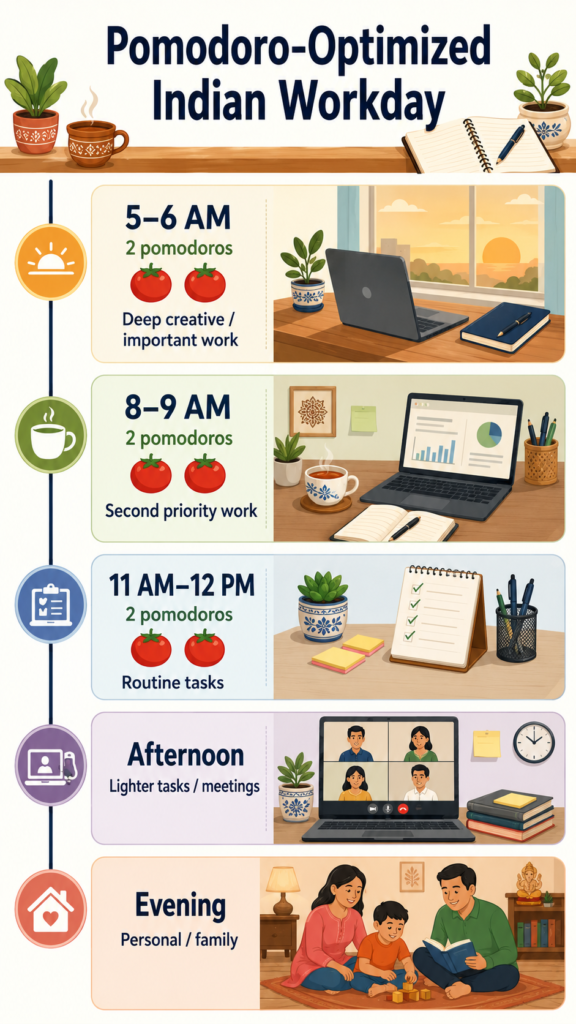
For teachers: Use 45-minute pomodoros aligned with class periods. Deep preparation and grading work well in longer blocks.
For home-based work with family interruptions: Communicate your pomodoro blocks. Even imperfect pomodoros with occasional interruptions are better than unfocused work.
Morning Brahma Muhurta alignment: Start your most important pomodoros during Brahma Muhurta (pre-sunrise) when the mind is naturally sharpest. Even 2–3 pomodoros before 7 AM produces more quality work than 8 hours of distracted effort.
What to Do During Breaks (This Is Where Most People Fail)
Most people use breaks to check Instagram — which provides no mental rest and extends to 30 minutes. Effective 5-minute breaks:
- Walk briefly, even inside the house
- Drink water mindfully
- Do 5 deep breaths (pranayama)
- Look at distant objects (rests eye muscles)
- Stretch neck and shoulders
Start With Just 4 Pomodoros a Day
That’s 2 hours of genuine deep work. Track your daily count in a notebook or app (Forest, Focus Keeper, or just a phone timer with tally marks).
Most knowledge workers are genuinely surprised to find they can complete a full day’s “important” work in 4–6 pomodoros. The rest of the day has been interruptions, social media, and unfocused busywork dressed up as productivity.
- A physical kitchen timer (analog, not digital) on Amazon.in — keeps your phone out of reach during sessions
- A Focus/productivity journal or planner on Amazon.in — to log your daily pomodoro count
- Noise-cancelling earplugs or earmuffs on Amazon.in — especially for joint-family or noisy environments
As an Amazon Associate, I earn from qualifying purchases. Prices vary — always check current listing before purchase.