


Updated: June 2026
The 3-List System
Most “start a side income” advice jumps straight to platforms — freelancing sites, social media, e-commerce setups — without addressing the actual reason most people never start: they don’t have a clear, written-down sense of what they’d even offer. Before any platform matters, three simple lists in a phone Notes app solve that problem completely, with zero cost and zero technical setup.
This isn’t a gimmick — it mirrors a structure freelancers and consultants actually use internally, just stripped down to its simplest possible form so anyone can start today.
List 1: What You Can Already Do
Write down every skill you have, no matter how unremarkable it feels — formatting Excel sheets neatly, writing clear WhatsApp messages, basic Canva design, explaining concepts simply to students, organizing a messy inbox, editing short videos, fixing common smartphone problems for relatives. Most people undervalue skills that feel “obvious” to them but are genuinely useful to someone else.
The goal isn’t to find your one big idea — it’s to get 8-10 honest entries on this list, even ones that feel too small to matter.
List 2: What People Actually Pay For
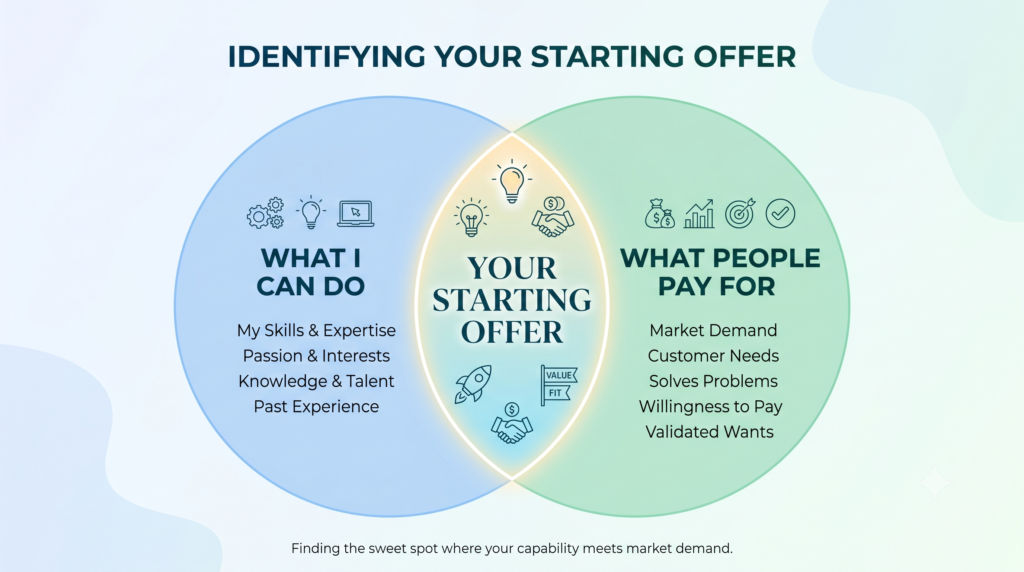
Cross-reference List 1 against real, observable demand – not guessed demand. Look at what people in your network actually complain about needing help with, what gigs show up repeatedly on freelancing platforms in categories close to your skills, and what small businesses near you visibly lack (a shop with no Instagram presence, a tutor with no organised study material, or a small business owner who manually tracks expenses on paper).
This list should end up shorter than List 1 – it’s the overlap between “I can do this” and “Someone would pay for this”, which is usually 2-4 items, not 10.
List 3: The Weekly Action Log
This is the list that actually moves things forward. Every week, write down exactly one small, concrete action tied to List 2 — message 3 people in your network about a specific offer, post one example of your work publicly, or reach out to one small business directly. The rule is that each entry must be specific enough to mark done/not done — “work on my side hustle” doesn’t count, but “message Sharma uncle’s shop about managing their Instagram for ₹1500/month” does.
Within 4-6 weeks of consistent entries, most people have either landed a first small client, made a first small sale, or learned something concrete enough to refine their offer — all from a free Notes app and zero upfront spending.
The Mistake That Stalls Most People Right Here
The most common failure point isn’t a bad idea on List 2 — it’s spending weeks perfecting List 1 and 2 without ever starting List 3. Polishing the idea feels productive and avoids the discomfort of an actual outreach message that might get ignored or rejected. But the lists only have value once they produce a real-world action, and a mediocre idea acted on consistently will outperform a perfect idea that never leaves the Notes app.
A useful guardrail: cap List 1 and List 2 work at one sitting, maybe 30-45 minutes total. If you’re still refining them after a week, that’s usually avoidance dressed up as preparation.
Are You Actually Ready to Start?
Use this quick check before diving in — it surfaces gaps worth fixing first rather than guessing.
🛠️ Mini-Tool: Side-Income Readiness Checklist
| ☐ | I have 8+ honest skills written down (List 1) |
| ☐ | I have at least 2 skill+demand overlaps identified (List 2) |
| ☐ | I can name one specific person/business I could approach this week |
| ☐ | I have a rough starting price in mind (even if it’s small) |
| ☐ | I’m willing to do this for free/cheap for the first client to build proof |
Reading your result: 4-5 ticks means you’re ready to start this week. 2-3 means spend a few more days on Lists 1 and 2 before acting. 0-1 means revisit List 1 — you likely haven’t given yourself credit for enough real skills yet.
What the First 30 Days Look Like
Realistically, the first 2 weeks are mostly List 1 and 2 work plus 4-6 outreach actions, often with no response or a “no.” Weeks 3-4 typically bring the first real conversation, even if it doesn’t convert immediately. This is normal and not a sign of failure — the weekly log exists specifically to make this slow period feel like progress instead of stagnation, since you can see concrete actions taken even when results haven’t shown up yet.
If you’re specifically drawn to AI-assisted income paths once you’ve found your overlap area, our piece on the Zero Rupee Challenge using ChatGPT pairs naturally with this system as a next step once List 2 is defined.
And if affiliate or content-based income is more your direction, our complete beginner’s guide to affiliate marketing for Indians covers that specific path in depth.
“Here are skills I have: [list 5-10 things you can do, even small ones]. Help me identify 3 realistic ways someone with these specific skills could earn extra income in India, starting with zero budget. For each idea, give me one concrete first action I could take this week to test it.”
FAQ
Q1: Do I need any special apps or tools to start this?
No — the entire system works in any free phone Notes app. Specialised tools only become useful once you have a defined offer and early demand.
Q2: What if my List 2 ends up empty?
That usually means List 1 needs more honest entries — most people have more marketable skills than they initially credit themselves with.
Q3: How much should I charge for my first client?
Pricing low (or even free) for the very first client is a reasonable strategy purely to build a real example and testimonial — raise prices once you have proof of results.
Q4: How long before this becomes meaningful income?
This varies enormously by skill, effort, and market – there’s no fixed timeline, which is exactly why the weekly action log matters more than any income projection.
- Ministry of Skill Development and Entrepreneurship (India) — gig economy and self-employment trends
- NITI Aayog — reports on India’s gig and platform economy
- General freelancing platform demand-category data (publicly available category listings)
We research publicly available economic and gig-work data and cite primary sources so you can verify everything yourself. Results vary by individual effort and market conditions — we make no income guarantees.